UDocumentation UE5.7 10.02.2026 (Source)
API documentation for Unreal Engine 5.7
FCurveEdInterface Class Reference

#include <CurveEdInterface.h>

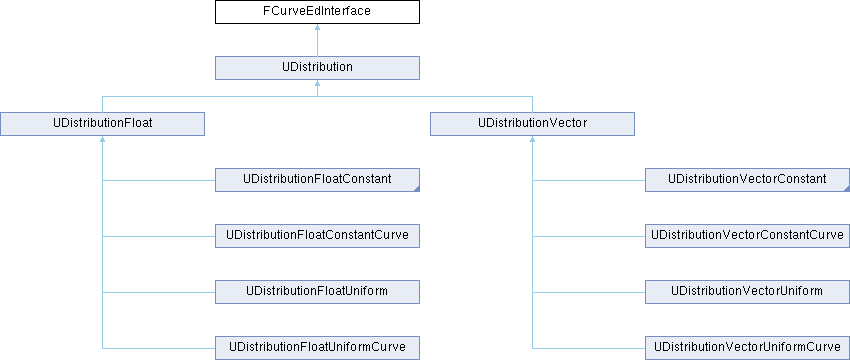
+ Inheritance diagram for FCurveEdInterface:

Public Member Functions

virtual int32 GetNumKeys () const
 
virtual int32 GetNumSubCurves () const
 
virtual FColor GetSubCurveButtonColor (int32 SubCurveIndex, bool bIsSubCurveHidden) const
 
virtual float GetKeyIn (int32 KeyIndex)
 
virtual float GetKeyOut (int32 SubIndex, int32 KeyIndex)
 
virtual FColor GetKeyColor (int32 SubIndex, int32 KeyIndex, const FColor &CurveColor)
 
virtual float EvalSub (int32 SubIndex, float InVal)
 
virtual EInterpCurveMode GetKeyInterpMode (int32 KeyIndex) const
 
virtual void GetTangents (int32 SubIndex, int32 KeyIndex, float &ArriveTangent, float &LeaveTangent) const
 
virtual void GetInRange (float &MinIn, float &MaxIn) const
 
virtual void GetOutRange (float &MinOut, float &MaxOut) const
 
virtual int32 CreateNewKey (float KeyIn)
 
virtual void DeleteKey (int32 KeyIndex)
 
virtual int32 SetKeyIn (int32 KeyIndex, float NewInVal)
 
virtual void SetKeyOut (int32 SubIndex, int32 KeyIndex, float NewOutVal)
 
virtual void SetKeyInterpMode (int32 KeyIndex, EInterpCurveMode NewMode)
 
virtual void SetTangents (int32 SubIndex, int32 KeyIndex, float ArriveTangent, float LeaveTangent)
 

Detailed Description

Interface that allows the CurveEditor to edit this type of object.

Member Function Documentation

◆ CreateNewKey()

virtual int32 FCurveEdInterface::CreateNewKey ( float  KeyIn)
inlinevirtual

Add a new key to the curve with the specified input. Its initial value is set using EvalSub at that location. Returns the index of the new key.

◆ DeleteKey()

virtual void FCurveEdInterface::DeleteKey ( int32  KeyIndex)
inlinevirtual

Remove the specified key from the curve. KeyIndex must be within range ie >=0 and < NumKeys.

◆ EvalSub()

virtual float FCurveEdInterface::EvalSub ( int32  SubIndex,
float  InVal 
)
inlinevirtual

Evaluate a subcurve at an arbitary point. Outside the keyframe range, curves are assumed to continue their end values.

◆ GetInRange()

virtual void FCurveEdInterface::GetInRange ( float MinIn,
float MaxIn 
) const
inlinevirtual

Get input range of keys. Outside this region curve continues constantly the start/end values.

Reimplemented in UDistributionFloat, and UDistributionVector.

◆ GetKeyColor()

virtual FColor FCurveEdInterface::GetKeyColor ( int32  SubIndex,
int32  KeyIndex,
const FColor CurveColor 
)
inlinevirtual

Provides the color for the given key at the given sub-curve.

Parameters
SubIndexThe index of the sub-curve
KeyIndexThe index of the key in the sub-curve
[in]CurveColorThe color of the curve
Returns
The color that is associated the given key at the given sub-curve

◆ GetKeyIn()

virtual float FCurveEdInterface::GetKeyIn ( int32  KeyIndex)
inlinevirtual

Get the input value for the Key with the specified index. KeyIndex must be within range ie >=0 and < NumKeys.

◆ GetKeyInterpMode()

virtual EInterpCurveMode FCurveEdInterface::GetKeyInterpMode ( int32  KeyIndex) const
inlinevirtual

Get the interpolation mode of the specified keyframe. This can be CIM_Constant, CIM_Linear or CIM_Curve. KeyIndex must be within range ie >=0 and < NumKeys.

◆ GetKeyOut()

virtual float FCurveEdInterface::GetKeyOut ( int32  SubIndex,
int32  KeyIndex 
)
inlinevirtual

Get the output value for the key with the specified index on the specified sub-curve. SubIndex must be within range ie >=0 and < NumSubCurves. KeyIndex must be within range ie >=0 and < NumKeys.

◆ GetNumKeys()

virtual int32 FCurveEdInterface::GetNumKeys ( ) const
inlinevirtual

Get number of keyframes in curve.

◆ GetNumSubCurves()

virtual int32 FCurveEdInterface::GetNumSubCurves ( ) const
inlinevirtual

Get number of 'sub curves' in this Curve. For example, a vector curve will have 3 sub-curves, for X, Y and Z.

◆ GetOutRange()

virtual void FCurveEdInterface::GetOutRange ( float MinOut,
float MaxOut 
) const
inlinevirtual

Get overall range of output values.

Reimplemented in UDistributionFloat, and UDistributionVector.

◆ GetSubCurveButtonColor()

virtual FColor FCurveEdInterface::GetSubCurveButtonColor ( int32  SubCurveIndex,
bool  bIsSubCurveHidden 
) const
inlinevirtual

Provides the color for the sub-curve button that is present on the curve tab.

Parameters
SubCurveIndexThe index of the sub-curve. Cannot be negative nor greater or equal to the number of sub-curves.
bIsSubCurveHiddenIs the curve hidden?
Returns
The color associated to the given sub-curve index.

◆ GetTangents()

virtual void FCurveEdInterface::GetTangents ( int32  SubIndex,
int32  KeyIndex,
float ArriveTangent,
float LeaveTangent 
) const
inlinevirtual

Get the incoming and outgoing tangent for the given subcurve and key. SubIndex must be within range ie >=0 and < NumSubCurves. KeyIndex must be within range ie >=0 and < NumKeys.

◆ SetKeyIn()

virtual int32 FCurveEdInterface::SetKeyIn ( int32  KeyIndex,
float  NewInVal 
)
inlinevirtual

Set the input value of the specified Key. This may change the index of the key, so the new index of the key is retured. KeyIndex must be within range ie >=0 and < NumKeys.

◆ SetKeyInterpMode()

virtual void FCurveEdInterface::SetKeyInterpMode ( int32  KeyIndex,
EInterpCurveMode  NewMode 
)
inlinevirtual

Set the method to use for interpolating between the give keyframe and the next one. KeyIndex must be within range ie >=0 and < NumKeys.

◆ SetKeyOut()

virtual void FCurveEdInterface::SetKeyOut ( int32  SubIndex,
int32  KeyIndex,
float  NewOutVal 
)
inlinevirtual

Set the output values of the specified key. SubIndex must be within range ie >=0 and < NumSubCurves. KeyIndex must be within range ie >=0 and < NumKeys.

◆ SetTangents()

virtual void FCurveEdInterface::SetTangents ( int32  SubIndex,
int32  KeyIndex,
float  ArriveTangent,
float  LeaveTangent 
)
inlinevirtual

Set the incoming and outgoing tangent for the given subcurve and key. SubIndex must be within range ie >=0 and < NumSubCurves. KeyIndex must be within range ie >=0 and < NumKeys.


The documentation for this class was generated from the following file: