#include <StereoRenderTargetManager.h>
|
| virtual bool | ShouldUseSeparateRenderTarget () const =0 |
| |
| virtual void | UpdateViewport (bool bUseSeparateRenderTarget, const class FViewport &Viewport, class SViewport *ViewportWidget=nullptr)=0 |
| |
| virtual void | CalculateRenderTargetSize (const class FViewport &Viewport, uint32 &InOutSizeX, uint32 &InOutSizeY)=0 |
| |
| virtual bool | NeedReAllocateViewportRenderTarget (const class FViewport &Viewport)=0 |
| |
| virtual bool | NeedReAllocateDepthTexture (const TRefCountPtr< struct IPooledRenderTarget > &DepthTarget) |
| |
| virtual bool | NeedReAllocateShadingRateTexture (const TRefCountPtr< struct IPooledRenderTarget > &ShadingRateTarget) |
| |
| virtual uint32 | GetNumberOfBufferedFrames () const |
| |
| virtual bool | AllocateRenderTargetTexture (uint32 Index, uint32 SizeX, uint32 SizeY, uint8 Format, uint32 NumMips, ETextureCreateFlags Flags, ETextureCreateFlags TargetableTextureFlags, FTextureRHIRef &OutTargetableTexture, FTextureRHIRef &OutShaderResourceTexture, uint32 NumSamples=1) |
| |
| virtual bool | AllocateRenderTargetTextures (uint32 SizeX, uint32 SizeY, uint8 Format, uint32 NumLayers, ETextureCreateFlags Flags, ETextureCreateFlags TargetableTextureFlags, TArray< FTextureRHIRef > &OutTargetableTextures, TArray< FTextureRHIRef > &OutShaderResourceTextures, uint32 NumSamples=1) |
| |
| virtual EPixelFormat | GetActualColorSwapchainFormat () const |
| |
| virtual int32 | AcquireColorTexture () |
| |
| virtual int32 | AcquireDepthTexture () |
| |
| virtual bool | AllocateDepthTexture (uint32 Index, uint32 SizeX, uint32 SizeY, uint8 Format, uint32 NumMips, ETextureCreateFlags Flags, ETextureCreateFlags TargetableTextureFlags, FTextureRHIRef &OutTargetableTexture, FTextureRHIRef &OutShaderResourceTexture, uint32 NumSamples=1) |
| |
| virtual bool | AllocateShadingRateTexture (uint32 Index, uint32 RenderSizeX, uint32 RenderSizeY, uint8 Format, uint32 NumMips, ETextureCreateFlags Flags, ETextureCreateFlags TargetableTextureFlags, FTextureRHIRef &OutTexture, FIntPoint &OutTextureSize) |
| |
| virtual bool | HDRGetMetaDataForStereo (EDisplayOutputFormat &OutDisplayOutputFormat, EDisplayColorGamut &OutDisplayColorGamut, bool &OutbHDRSupported) |
| |
| virtual bool | ReconfigureForShaderPlatform (EShaderPlatform NewShaderPlatform) |
| |
| virtual bool | GetRecommendedMotionVectorTextureSize (FIntPoint &OutTextureSize) |
| |
| virtual bool | GetMotionVectorTexture (uint32 Index, const FIntPoint &Size, uint8 Format, uint32 NumMips, ETextureCreateFlags Flags, FTextureRHIRef &OutTexture, uint32 NumSamples=1) |
| |
| virtual bool | GetMotionVectorDepthTexture (uint32 Index, const FIntPoint &Size, uint8 Format, uint32 NumMips, ETextureCreateFlags Flags, FTextureRHIRef &OutTexture, uint32 NumSamples=1) |
| |
The IStereoRenderTargetManager can be returned from IStereoRendering::GetRenderTargetManager() implementations. Implement this interface if a stereo rendering device requires all output to be rendered into separate render targets and/or to customize how separate render targets are allocated.
◆ AcquireColorTexture()
| virtual int32 IStereoRenderTargetManager::AcquireColorTexture |
( |
| ) |
|
|
inlinevirtual |
Acquires the next available color texture.
- Returns
- the index of the texture in the array returned by AllocateRenderTargetTexture.
◆ AcquireDepthTexture()
| virtual int32 IStereoRenderTargetManager::AcquireDepthTexture |
( |
| ) |
|
|
inlinevirtual |
Acquires the next available depth texture.
- Returns
- the index of the texture in the array returned by AllocateRenderTargetTexture.
◆ AllocateDepthTexture()
Allocates a depth texture.
- Parameters
-
- Returns
- true, if texture was allocated; false, if the default texture allocation should be used.
◆ AllocateRenderTargetTexture()
Allocates a render target texture. The default implementation always return false to indicate that the default texture allocation should be used instead.
- Parameters
-
- Returns
- true, if texture was allocated; false, if the default texture allocation should be used.
◆ AllocateRenderTargetTextures()
Allocates the render target textures, which includes the color textures and optionally other textures like depth. The default implementation always returns false to indicate that the default texture allocation should be used instead.
- Returns
- true, if textures were allocated; false, if the default texture allocation should be used.
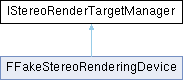
Reimplemented in FFakeStereoRenderingDevice.
◆ AllocateShadingRateTexture()
Allocates a shading rate texture. The default implementation always returns false to indicate that the default texture allocation should be used instead.
- Parameters
-
- Returns
- true, if texture was allocated; false, if the default texture allocation should be used.
◆ CalculateRenderTargetSize()
◆ GetActualColorSwapchainFormat()
Returns pixel format that the device created its swapchain with (which can be different than what was requested in AllocateRenderTargetTexture)
◆ GetMotionVectorDepthTexture()
Allocates a motion vector depth texture. The default implementation always returns false to indicate that the stereo device doesn't support motion vector depth textures.
- Parameters
-
| Size | (in) requested motion vector depth texture size |
| Format | (in) requested motion vector depth texture format |
| NumMips | (in) requested motion vector depth texture mips count |
| Flags | (in) requested motion vector depth texture flags |
| OutTexture | (out) motion vector depth texture resource allocated by the stereo device |
| NumSamples | (in) requested motion vector depth texture samples count |
- Returns
- true, if texture was allocated; false, if the stereo device can't provide a texture.
◆ GetMotionVectorTexture()
Allocates a motion vector texture. The default implementation always returns false to indicate that the stereo device does not support motion vector textures.
- Parameters
-
| Size | (in) requested motion vector texture size |
| Format | (in) requested motion vector texture format |
| NumMips | (in) requested motion vector texture mips count |
| Flags | (in) requested motion vector texture flags |
| OutTexture | (out) motion vector texture resource allocated by the stereo device |
| NumSamples | (in) requested motion vector texture samples count |
- Returns
- true, if texture was allocated; false, if the stereo device can't provide a texture.
◆ GetNumberOfBufferedFrames()
| virtual uint32 IStereoRenderTargetManager::GetNumberOfBufferedFrames |
( |
| ) |
const |
|
inlinevirtual |
Returns number of required buffered frames.
◆ GetRecommendedMotionVectorTextureSize()
| virtual bool IStereoRenderTargetManager::GetRecommendedMotionVectorTextureSize |
( |
FIntPoint & |
OutTextureSize | ) |
|
|
inlinevirtual |
Gets the size of the motion vector texture recommended by the stereo device. Allocating a motion vector texture of any other size may be detrimental to performance or be unsupported by the stereo device.
- Parameters
-
| OutTextureSize | (out) The size of the motion vector texture. |
- Returns
- true, if the stereo device can recommend a texture size; false, if not.
◆ GetStereoLayerPixelFormat()
◆ HDRGetMetaDataForStereo()
Retrieves HDR information about the stereo device, if any is available. The default implementation always returns false to indicate that the information from the monitor can be used instead.
- Parameters
-
| OutDisplayOutputFormat | (out) encoding used by the stereo device |
| OutDisplayColorGamut | (out) color space used by the stereo device |
| OutbHDRSupported | (out) whether HDR is supported by the stereo device |
- Returns
- true, if HDR information is available for the stereo device
◆ NeedReAllocateDepthTexture()
Returns true, if render target texture must be re-calculated.
◆ NeedReAllocateShadingRateTexture()
Returns true, if shading rate texture must be re-calculated.
◆ NeedReAllocateViewportRenderTarget()
| virtual bool IStereoRenderTargetManager::NeedReAllocateViewportRenderTarget |
( |
const class FViewport & |
Viewport | ) |
|
|
pure virtual |
◆ ReconfigureForShaderPlatform()
In the editor, we may switch between preview shader platforms, which support various single-pass rendering methods (e.g. InstancedStereo or MobileMultiView). Sometimes RT managers have their own state that depends on the method, so this API provides them with the possibility to reconfigure it
◆ ShouldUseSeparateRenderTarget()
| virtual bool IStereoRenderTargetManager::ShouldUseSeparateRenderTarget |
( |
| ) |
const |
|
pure virtual |
Whether a separate render target should be used or not. In case the stereo rendering implementation does not require special handling of separate render targets at all, it can leave out implementing this interface completely and simply let the default implementation of IStereoRendering::GetRenderTargetManager() return nullptr.
Implemented in FFakeStereoRenderingDevice.
◆ UpdateViewport()
| virtual void IStereoRenderTargetManager::UpdateViewport |
( |
bool |
bUseSeparateRenderTarget, |
|
|
const class FViewport & |
Viewport, |
|
|
class SViewport * |
ViewportWidget = nullptr |
|
) |
| |
|
pure virtual |
Updates viewport for direct rendering of distortion. Should be called on a game thread.
- Parameters
-
| bUseSeparateRenderTarget | Set to true if a separate render target will be used. Can potentiallt be true even if ShouldUseSeparateRenderTarget() returned false earlier. |
| Viewport | The Viewport instance calling this method. |
| ViewportWidget | (optional) The Viewport widget containing the view. Can be used to access SWindow object. |
Implemented in FFakeStereoRenderingDevice.
The documentation for this class was generated from the following file:

 Inheritance diagram for IStereoRenderTargetManager:
 1.9.8
1.9.8