#include <UniquePtr.h>
◆ ElementType
◆ TUniquePtr() [1/8]
◆ TUniquePtr() [2/8]
Default constructor - initializes the TUniquePtr to null.
◆ TUniquePtr() [3/8]
Pointer constructor - takes ownership of the pointed-to object
- Parameters
-
| InPtr | The pointed-to object to take ownership of. |
◆ TUniquePtr() [4/8]
Pointer constructor - takes ownership of the pointed-to object
- Parameters
-
| InPtr | The pointed-to object to take ownership of. |
◆ TUniquePtr() [5/8]
Pointer constructor - takes ownership of the pointed-to object
- Parameters
-
| InPtr | The pointed-to object to take ownership of. |
◆ TUniquePtr() [6/8]
nullptr constructor - initializes the TUniquePtr to null.
◆ TUniquePtr() [7/8]
◆ TUniquePtr() [8/8]
Constructor from rvalues of other (usually derived) types
◆ ~TUniquePtr()
◆ Get()
Returns a pointer to the owned object without relinquishing ownership.
- Returns
- A copy of the pointer to the object owned by the TUniquePtr, or nullptr if no object is being owned.
◆ GetDeleter() [1/2]
Returns a reference to the deleter subobject.
- Returns
- A reference to the deleter.
◆ GetDeleter() [2/2]
Returns a reference to the deleter subobject.
- Returns
- A reference to the deleter.
◆ IsValid()
Tests if the TUniquePtr currently owns an object.
- Returns
- true if the TUniquePtr currently owns an object, false otherwise.
◆ operator bool()
operator bool
- Returns
- true if the TUniquePtr currently owns an object, false otherwise.
◆ operator!=() [1/2]
Inequality comparison operator
- Parameters
-
- Returns
- false if the two TUniquePtrs are logically substitutable for each other, true otherwise.
◆ operator!=() [2/2]
Inequality comparison operator against nullptr.
- Parameters
-
- Returns
- true if the TUniquePtr is not null, false otherwise.
◆ operator*()
template<
typename DummyT = T UE_REQUIRES(UE_REQUIRES_EXPR(*(DummyT*)nullptr))>
Dereference operator
- Returns
- A reference to the object owned by the TUniquePtr.
◆ operator->()
Indirection operator
- Returns
- A pointer to the object owned by the TUniquePtr.
◆ operator<()
Less-than comparison operator
- Parameters
-
- Returns
- true if the inner pointer of the left TUniquePtr is less than the inner pointer of the right, false otherwise.
◆ operator<=()
Less-than-or-equals comparison operator
- Parameters
-
- Returns
- true if the inner pointer of the left TUniquePtr is less than or equal to the inner pointer of the right, false otherwise.
◆ operator=() [1/4]
◆ operator=() [2/4]
◆ operator=() [3/4]
Assignment operator for rvalues of other (usually derived) types
◆ operator=() [4/4]
Nullptr assignment operator
◆ operator==() [1/2]
Equality comparison operator
- Parameters
-
- Returns
- true if the two TUniquePtrs are logically substitutable for each other, false otherwise.
◆ operator==() [2/2]
Equality comparison operator against nullptr.
- Parameters
-
- Returns
- true if the TUniquePtr is null, false otherwise.
◆ operator>()
Greater-than comparison operator
- Parameters
-
- Returns
- true if the inner pointer of the left TUniquePtr is greater than the inner pointer of the right, false otherwise.
◆ operator>=()
Greater-than-or-equals comparison operator
- Parameters
-
- Returns
- true if the inner pointer of the left TUniquePtr is greater than or equal to the inner pointer of the right, false otherwise.
◆ Release()
Relinquishes control of the owned object to the caller and nulls the TUniquePtr.
- Returns
- The pointer to the object that was owned by the TUniquePtr, or nullptr if no object was being owned.
◆ Reset()
Gives the TUniquePtr a new object to own, destroying any previously-owned object.
- Parameters
-
| InPtr | A pointer to the object to take ownership of. |
◆ GetTypeHash
◆ TUniquePtr
The documentation for this class was generated from the following file:
- Engine/Source/Runtime/Core/Public/Templates/UniquePtr.h

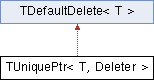
 Inheritance diagram for TUniquePtr< T, Deleter >:
 1.9.8
1.9.8