#include <AudioChannelFormatConverter.h>
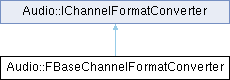
FBaseChannelFormatConverter implements channel conversion using a simple mixing matrix.
◆ ~FBaseChannelFormatConverter()
| Audio::FBaseChannelFormatConverter::~FBaseChannelFormatConverter |
( |
| ) |
|
|
virtualdefault |
◆ FBaseChannelFormatConverter()
◆ CreateBaseFormatConverter()
Create a FBaseChannelFormatConverter
- Parameters
-
| InInputFormat | - The format of the input audio. |
| InOutputFormat | - The desired output audio format. |
| InMixEntries | - An array of mixing values to use to mix input audio to output audio. |
| InNumFramesPerCall | - The number of frames used for each call to ProcessAudio. |
- Returns
- A TUniquePtr to a FBaseChannelFormatConverter.
◆ GetInputFormat()
◆ GetOutputFormat()
◆ GetTargetMixGain()
| float Audio::FBaseChannelFormatConverter::GetTargetMixGain |
( |
int32 |
InInputChannelIndex, |
|
|
int32 |
InOutputChannelIndex |
|
) |
| const |
Returns the scalar gain used to mix the input channel index into the output channel index.
If the gains are to be faded during the subsequent call to ProcessAudio(), this will return the ending gain.
◆ GetTargetOutputGain()
| float Audio::FBaseChannelFormatConverter::GetTargetOutputGain |
( |
| ) |
const |
Returns the scalar gain applied to the output audio.
If the gain is to be faded during the subsequent call to ProcessAudio(), this will return the ending gain.
◆ ProcessAudio()
Converter the audio format from the FInputFormat to the FOutputFormat.
The input buffer array must have the same number of channels as the FInputFormat return from GetInputFormat(). Each buffer within that array must have InNumFramesPerCall as set on creation.
- Parameters
-
| InInputBuffers | - An array of input audio buffers. |
| OutOutputBuffers | - An array of buffers where output audio is stored. |
Implements Audio::IChannelFormatConverter.
◆ SetMixGain() [1/2]
Sets the gain scalar to apply to a specific input/output channel pair.
- Parameters
-
| InMixEntry | - Description of mix routing and gain. |
| bFadeToGain | - If true, gain values are linearly faded over the duration of a single buffer. If false, gain values are applied immediately. |
◆ SetMixGain() [2/2]
| void Audio::FBaseChannelFormatConverter::SetMixGain |
( |
int32 |
InInputChannelIndex, |
|
|
int32 |
InOutputChannelIndex, |
|
|
float |
InGain, |
|
|
bool |
bFadeToGain = true |
|
) |
| |
Sets the gain scalar to apply to a specific input/output channel pair.
- Parameters
-
| InInputChannelIndex | - The index of the source channel audio. |
| InOutputChannelIndex | - The index of the destination channel audio. |
| InGain | - The scalar gain to apply to the source channel before adding it to the destination channel. |
| bFadeToGain | - If true, gain values are linearly faded over the duration of a single buffer. If false, gain values are applied immediately. |
◆ SetOutputGain()
| void Audio::FBaseChannelFormatConverter::SetOutputGain |
( |
float |
InOutputGain, |
|
|
bool |
bFadeToGain = true |
|
) |
| |
Sets the output gain scalar to apply to all output audio.
- Parameters
-
| InOutputGain | - Scalar gain value. |
| bFadeToGain | - If true, gain values are linearly faded over the duration of a single buffer. If false, gain values are applied immediately. |
The documentation for this class was generated from the following files:

 Inheritance diagram for Audio::FBaseChannelFormatConverter:
 1.9.8
1.9.8