UDocumentation UE5.7 10.02.2026 (Source)
API documentation for Unreal Engine 5.7
FTypedElementHandle Struct Reference

#include <TypedElementHandle.h>

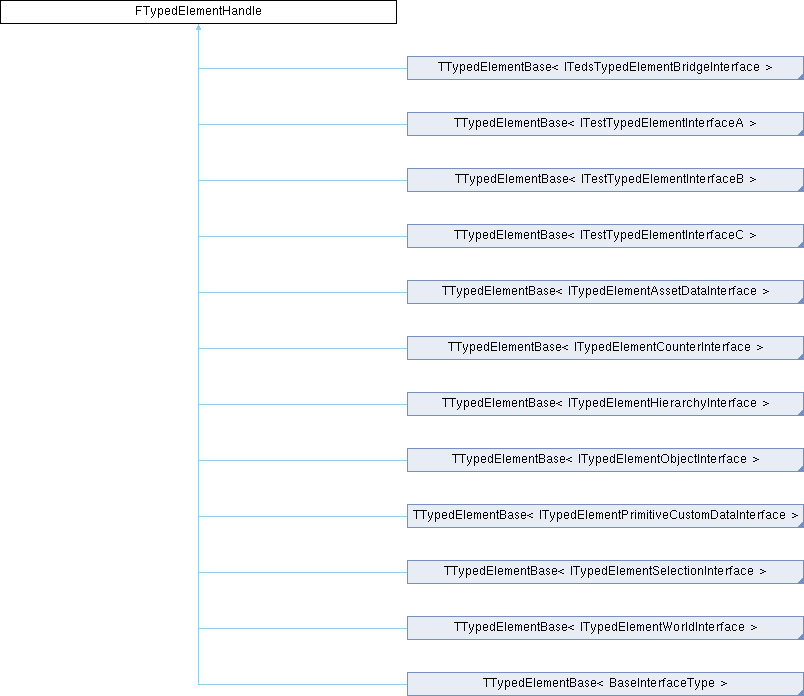
+ Inheritance diagram for FTypedElementHandle:

Public Member Functions

 FTypedElementHandle ()=default
 
 FTypedElementHandle (const FTypedElementHandle &InOther)
 
FTypedElementHandleoperator= (const FTypedElementHandle &InOther)
 
 FTypedElementHandle (FTypedElementHandle &&InOther)
 
FTypedElementHandleoperator= (FTypedElementHandle &&InOther)
 
 ~FTypedElementHandle ()
 
 operator bool () const
 
bool IsSet () const
 
void Release ()
 
const FTypedElementIdGetId () const
 
template<typename ElementDataType >
bool IsDataOfType () const
 
template<typename ElementDataType >
const ElementDataType * GetData (const bool bSilent=false) const
 
template<typename ElementDataType >
const ElementDataType & GetDataChecked () const
 
FTypedElementId AcquireId () const
 
void ReleaseId (FTypedElementId &InOutElementId) const
 
void Private_InitializeNoRef (const FTypedElementInternalData &InData)
 
void Private_InitializeAddRef (const FTypedElementInternalData &InData)
 
void Private_DestroyNoRef ()
 
void Private_DestroyReleaseRef ()
 
const FTypedElementInternalDataPrivate_GetInternalData () const
 

Friends

bool operator== (const FTypedElementHandle &InLHS, const FTypedElementHandle &InRHS)
 
bool operator!= (const FTypedElementHandle &InLHS, const FTypedElementHandle &InRHS)
 
uint32 GetTypeHash (const FTypedElementHandle &InElementHandle)
 

Detailed Description

A representation of an element that includes its handle data. This type is the most standard way that an element is passed through to interfaces, and also the type that is stored in element lists. C++ code may choose to use TTypedElement instead, which is a combination of an element handle and its associated element interface.

Note
Handles auto-release on destruction.

Constructor & Destructor Documentation

◆ FTypedElementHandle() [1/3]

FTypedElementHandle::FTypedElementHandle ( )
default

◆ FTypedElementHandle() [2/3]

FTypedElementHandle::FTypedElementHandle ( const FTypedElementHandle InOther)
inline

◆ FTypedElementHandle() [3/3]

FTypedElementHandle::FTypedElementHandle ( FTypedElementHandle &&  InOther)
inline

◆ ~FTypedElementHandle()

FTypedElementHandle::~FTypedElementHandle ( )
inline

Member Function Documentation

◆ AcquireId()

FTypedElementId FTypedElementHandle::AcquireId ( ) const
inline

Acquire a copy of the ID that this element represents.

Note
This must be paired with a call to ReleaseId.

◆ GetData()

template<typename ElementDataType >
const ElementDataType * FTypedElementHandle::GetData ( const bool  bSilent = false) const
inline

Attempt to access the data stored within this handle as the given type, returning null if it isn't possible and logging an access error for scripting.

Note
This is not typically something you'd want to use outside of data access within an interface implementation.

◆ GetDataChecked()

template<typename ElementDataType >
const ElementDataType & FTypedElementHandle::GetDataChecked ( ) const
inline

Attempt to access the data stored within this handle as the given type, asserting if it isn't possible.

Note
This is not typically something you'd want to use outside of data access within an interface implementation.

◆ GetId()

const FTypedElementId & FTypedElementHandle::GetId ( ) const
inline

Get the ID that this element represents.

◆ IsDataOfType()

template<typename ElementDataType >
bool FTypedElementHandle::IsDataOfType ( ) const
inline

Test to see whether the data stored within this handle is of the given type.

Note
This is not typically something you'd want to query outside of data access within an interface implementation.

◆ IsSet()

bool FTypedElementHandle::IsSet ( ) const
inline

Has this handle been initialized to a valid element?

◆ operator bool()

FTypedElementHandle::operator bool ( ) const
inlineexplicit

◆ operator=() [1/2]

FTypedElementHandle & FTypedElementHandle::operator= ( const FTypedElementHandle InOther)
inline

◆ operator=() [2/2]

FTypedElementHandle & FTypedElementHandle::operator= ( FTypedElementHandle &&  InOther)
inline

◆ Private_DestroyNoRef()

void FTypedElementHandle::Private_DestroyNoRef ( )
inline

◆ Private_DestroyReleaseRef()

void FTypedElementHandle::Private_DestroyReleaseRef ( )
inline

◆ Private_GetInternalData()

const FTypedElementInternalData * FTypedElementHandle::Private_GetInternalData ( ) const
inline

◆ Private_InitializeAddRef()

void FTypedElementHandle::Private_InitializeAddRef ( const FTypedElementInternalData InData)
inline

◆ Private_InitializeNoRef()

void FTypedElementHandle::Private_InitializeNoRef ( const FTypedElementInternalData InData)
inline

◆ Release()

void FTypedElementHandle::Release ( )
inline

Release this handle and set it back to an empty state.

◆ ReleaseId()

void FTypedElementHandle::ReleaseId ( FTypedElementId InOutElementId) const
inline

Release a copy of the ID that this element represents.

Note
This should have come from a call to AcquireId.

Friends And Related Symbol Documentation

◆ GetTypeHash

uint32 GetTypeHash ( const FTypedElementHandle InElementHandle)
friend

◆ operator!=

bool operator!= ( const FTypedElementHandle InLHS,
const FTypedElementHandle InRHS 
)
friend

◆ operator==

bool operator== ( const FTypedElementHandle InLHS,
const FTypedElementHandle InRHS 
)
friend

The documentation for this struct was generated from the following file: